Trumpet Dating/1
Let me, give you the logic behind some PROPHECY DATING of the 7 TRUMPETS
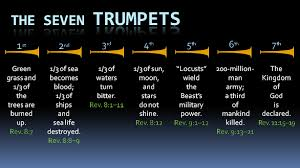
-There are 7 Trumpets blown in Revelation for the 3.5 Years of Great Tribulation (I have gotten all the dates correct so far) as now is the blowing of the 1st Trumpet Rev 8:5
When is the Second ? Third ? Fourth ? Lets go over it logically !
Trumpets/2
But we know by now that every important event must take place on a HEBREW HOLY DAY... even as the Day of Atonement nears OCT 1/2.Yes, but surely the next major event has to take place on the PASSOVER after the destruction, we FLEE... and thats way off in April 1-9th 2026
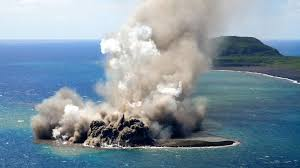
Whao, thats a long time to wait for the Second Trumpet..(Mona Loa Volcano explodes in Hawaii) but it does make absolute sense for the time when we Gather and flee Jerusalem.
Trumpet Dating/3
But according to the Chronological Series of End Time Events, we only flee after the Nuclear War, and after the Russian A.C. has descended down to Jerusalem, ...south, east and towards the Pleasant land (Daniel 8)
He becomes the ruler of the world and we head for Petra following the 2 Witnesses (Rev 11 Zech 4). So the only dates I knowof between Oct 2 and April 9 is 50 days later, November 20th, or ( January 17th, the day of death and sacrificing,) and the Pacific 2nd Trumpet that kills so man is an upswelling from the now underwater Volcano off the coast of the Big Island in Hawaii. Hmmm.
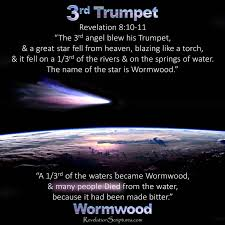
The 3rd Trumpet is the comet Wormwood that destroys all or almost all FRESH WATER in the world.
(This A.K.A. like be our End Time Elijah, as he or me has struck the water, and there will not be rain in Israel for 3.5 years) Israel has withheld food and WATER from the Palestinians, so rightly they get no water in the Great Tribulation... maybe this is blown on January 17, 2026
7 Trumpet/2A
This a confirmation of Mathew 24. April is after this year's 'winter'
Pray that your flight be not in the winter," comes from Jesus' Olivet Discourse in Matthew 24:20, warning his followers to pray for their escape from the impending tribulation not to occur in the difficult conditions of winter or on the Sabbath, which would hinder travel and safety.
1/3 can simply be looking horizontally there is enough pollution cloud cover to stop us, on Earth from seeing
celstial bodies like the Sun, Moon and Stars along the horizon, but still able to see upwards or vertically somewhat to view them. We shall see, or lets say NOT SEE
The 4th Trumpet, says the Sun, Moon and Stars will not shine. That agains seems to be a layer of red ash that turned the Oceans red, and Volcanic ash and Wormwood that smote the inland fresh water with clouds enough to prevent SUNshine and heat from penetrating to warm the Earth
T.D./5
You must remember that Elijah of the End Time has stopped the rain in the Mid East, and has caused a drought. But there can be clouds without rain, darkness without the rising Sun, drought and famine, even as Gates and his ilk have stopped the rain and clouded the sky via their chemtrails.
T.D. /6
So again, this 4th Trumpet, surely has to proceed our FLIGHT to Petra, just after PASSOVER. (April 20th 2026) This again paralleling Moses and His 2nd Exodus
https://davidjayjordan.com/2ndExodus2.html
T.D/7
Thus, we have
1st Trumpet ---- now
2nd Trumpet -- Days from now - mid November 2025
3rd Trumpet -- January 17th ? Wormwood
4th Trumpet --- March-April 2026 - Gather
Fleeing to Petra --- April 9th
5th Trumpet -- Easy one subtract 5 months
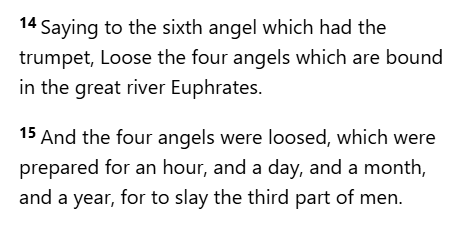
6th Trumpet -- Another Easy one - 1yr-1mon-1day
7th Trumpet -- August 10th Rapture
Prophet David Jay Jordan
@DavidJayJordan
·
Sep 27
T.D./8
Get out your pens and paper, and we'll calculate the day dating of the 5th and 6th Trumpets. or use Day Counter. Look up Revelations 9, see the time frames and subtract from the Rapture Date
I cant do all the work for ya ! Back later and well check answers.
https://timeanddate.com/date/duration.html
T.D/9
Did you do your homework ?
From the Rapture Date, that you looked up..August 10th 2028, the Wheat Harvest you have to go back 1 year, 1 month, and 1 hour to what date for the 6th Trumpet. ..... equals July 11th 2027 (+/- 3.5 days)
T.D. 10
Hmm.. accordingly the Torah reading for July 10th 2027 is ... 'Some rebels are swallowed by the ground, while others are consumed by a fire from God and others die in a PLAGUE.' I'll take that as a confirmation of the scorpions with tails biting the heathen and AC people of the world for over a year.
TD/11
OK, 6th, and yet go back one Trumpet and NUMBER 5, is FIVE months previous. Via the Day Counter subtract 545Days from Aug.10, 2028 equals..... February 12 (+/- 3.5 days)
from https://chabad.org/calendar/view/day.asp?tdate=2/12/2027
Hmmm Thats ... interesting as Our End Time Moses, and our High Priestess, take over our End Time Children of God in going into the Promised Land
Looks reasonable and incorporates Prophetic Events, so
lets see if it stands the test of time, and whether the Lord confirms the beginning to give us more confidence in its ENDING
T.D/12
Update
1st Trumpet ---- now
2nd Trumpet -- 50 Days - mid Nov. 2025
3rd Trumpet -- January 17th ? Wormwood
4th Trumpet --- March- 2026 - Gather
Fleeing to Petra --- April 9th 2026
5th Trumpet -- Feb. 12th 2027
6th Trumpet -- July 11th.2027
7th Trumpet -- August 10th Rapture
T.D./13
Remember our 2 Witnesses, Prophets, Candle Sticks, Pillars, Joachin and Boaz, according to all scriptures smite the Earth with these plagues via their Trumpet Blowing. Read Revelation 11 ........ for these Two shall smite the Earth and the AntiChrist People
TD/14
And look again, our 2 Elijahs, me being one, have power to SHUT Heaven, and produce drought in the End Time, especially in Israel. For even the 5th Trumpet of LOCUSTS happens during drought periods. The Lord withholds the End Time Rain and water to Israel
https://endtimeprophecies.net/elijah_in_the_end_time